View 1View 2Wrist
S1 · Pick & place
Pick & place
“Put the yellow block in the blue cup.”
Imagine. Act. Evolve.
A World-Model-Centric Framework for Continuous Self-Evolution of Modular Embodied Skills
1Tsinghua University · 2University of Oxford · 3University of Sussex · 4Beijing Jiaotong University · 5Xiamen University · 6East China Normal University
* Equal contribution · ‡ Project leader · † Corresponding authors
Abstract
Current progress in physical intelligence largely relies on scaling monolithic Vision-Language-Action (VLA) models, yet real-world policy data remain fragmented across scenes and tasks. This mismatch limits transfer, exacerbates catastrophic forgetting, and impedes continual improvement. A modular design that shares dynamics while specializing skills is therefore a promising paradigm.
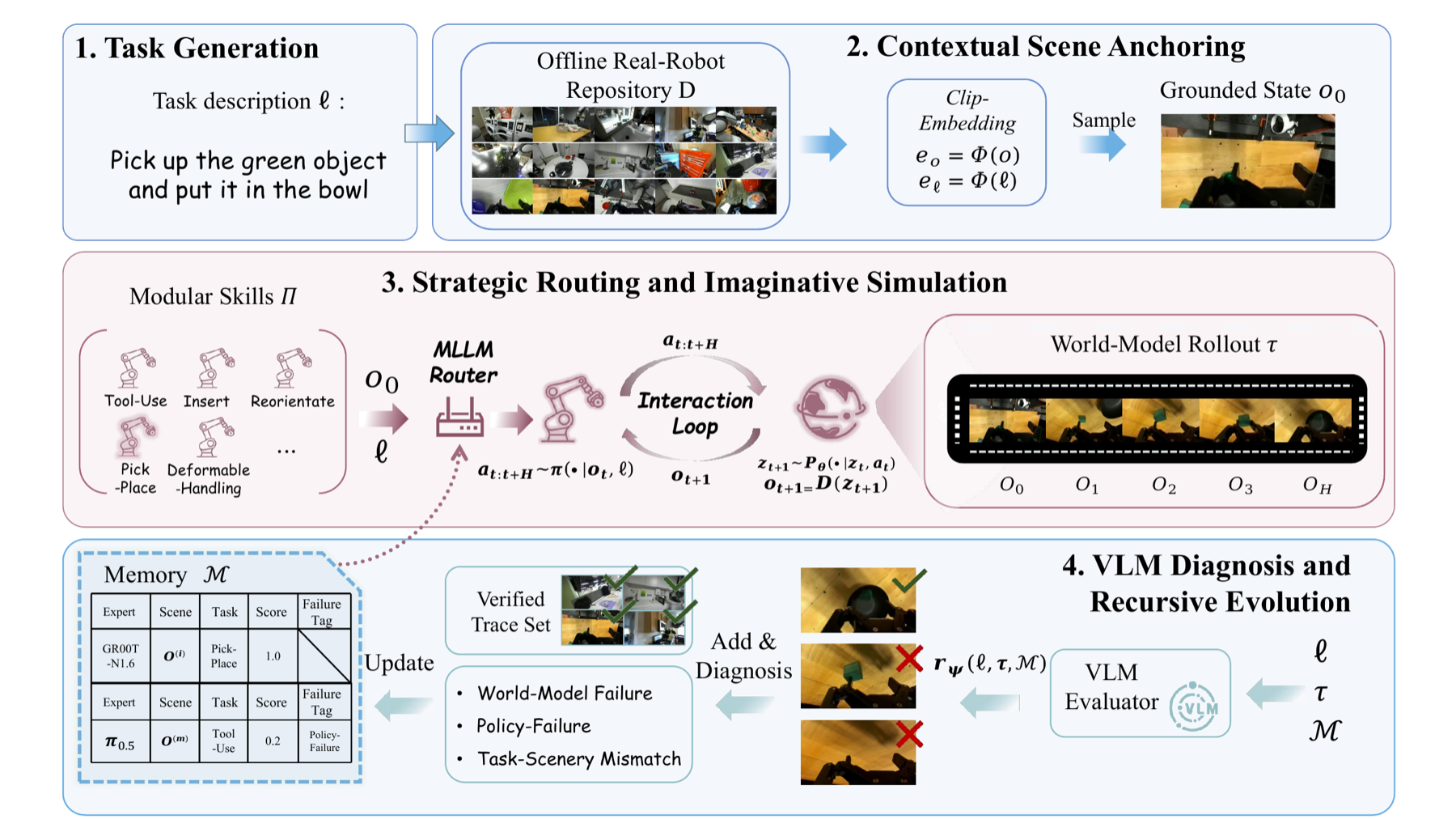
We introduce EvoWorld (EvoW), a world-model-centric framework for skill orchestration and iterative self-evolution. VLAs form an expandable library of pluggable experts. A high-level router selects experts conditioned on scene and task, while an action-conditioned video world model serves as the cognitive core for rollout-based planning. A vision-language evaluator delivers semantic scoring and diagnostic tags, enabling targeted updates to the world model, router memory, or specific experts rather than global retraining.
Method
Every task passes through the same closed loop. Select a step to see what happens there.
A task description is matched against an offline repository of real-robot recordings with CLIP embeddings, and a grounded initial state is sampled, so every generated task begins in a scene the robot has actually seen.
Output: a grounded state o₀ for the task ℓ.
Demos
Generated world-model rollouts and physical robot footage are shown separately and labeled.
“Put the yellow block in the blue cup.”
“Put the cup upright.”
“Use the white towel to wipe the table.”
Franka arm · complete 115-second recording at 5× speed · no audio
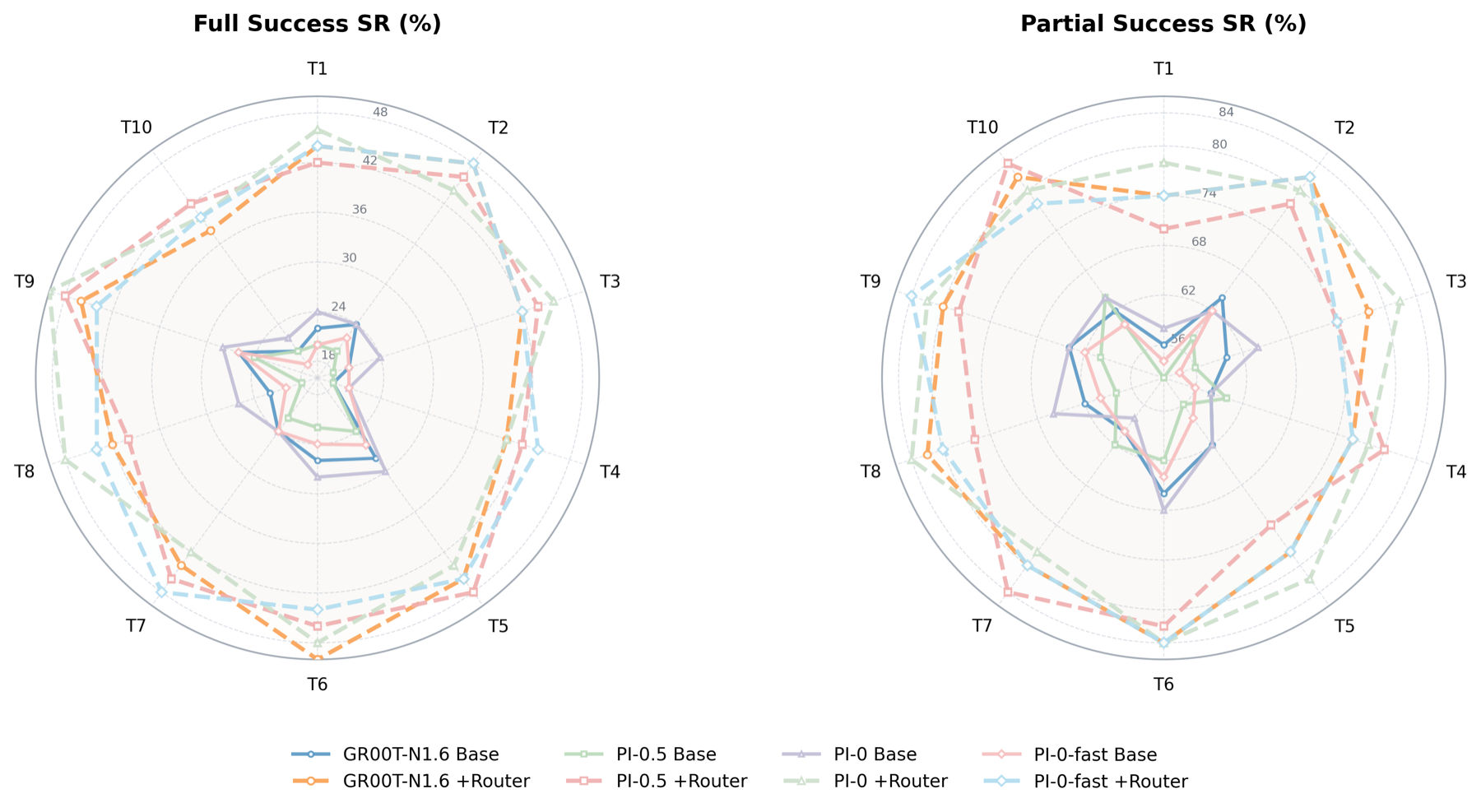
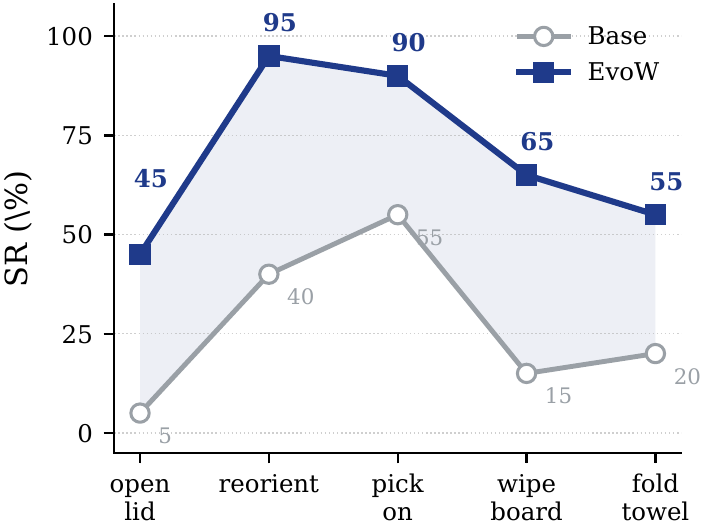
Success rate per task, base GR00T-N1.6 policy vs. with EvoWorld, 20 trials each (rebuttal study).
Results
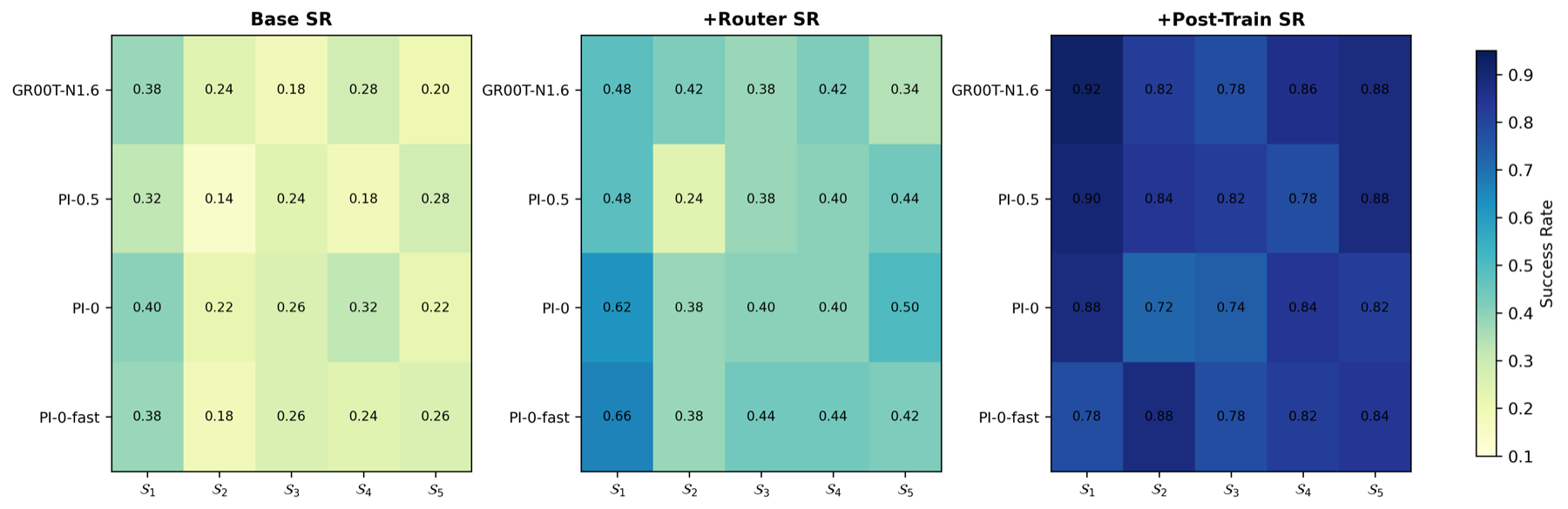
Mean success rises by 18.9 percentage points across four VLA backbones, with relative gains from +62.0% to +82.8%.
Table 1 · five skill families · choose a backbone
All four backbones
Mean over the four backbones
| Backbone | Setting | S1 | S2 | S3 | S4 | S5 | Avg | Gain |
|---|---|---|---|---|---|---|---|---|
| GR00T-N1.6 | Base | 0.38 | 0.24 | 0.18 | 0.28 | 0.20 | 0.256 | -- |
| EvoW* | 0.48 | 0.50 | 0.46 | 0.42 | 0.48 | 0.468 | +82.8% | |
| PI-0.5 | Base | 0.32 | 0.14 | 0.24 | 0.18 | 0.28 | 0.232 | -- |
| EvoW* | 0.48 | 0.28 | 0.38 | 0.44 | 0.48 | 0.412 | +77.6% | |
| PI-0 | Base | 0.40 | 0.22 | 0.26 | 0.32 | 0.22 | 0.284 | -- |
| EvoW* | 0.62 | 0.38 | 0.40 | 0.40 | 0.50 | 0.460 | +62.0% | |
| PI-0-fast | Base | 0.38 | 0.18 | 0.26 | 0.24 | 0.26 | 0.264 | -- |
| EvoW* | 0.66 | 0.38 | 0.44 | 0.36 | 0.42 | 0.452 | +71.2% |
| Metric | EvoW | RoboGen | Behavior-100 | RLBench | MetaWorld | ManiSkill2 | GenSim |
|---|---|---|---|---|---|---|---|
| Number of tasks | 100 | 106 | 100 | 106 | 50 | 20 | 70 |
| Task description Self-BLEU | 0.281 | 0.284 | 0.299 | 0.317 | 0.322 | 0.674 | 0.378 |
| Task description Sentence-BERT similarity | 0.312 | 0.165 | 0.210 | 0.200 | 0.263 | 0.194 | 0.288 |
| Scene image ViT similarity | 0.337 | 0.193 | 0.389 | 0.375 | 0.517 | 0.332 | 0.717 |
| Scene image CLIP similarity | 0.754 | 0.762 | 0.833 | 0.864 | 0.867 | 0.828 | 0.932 |


Citation
@inproceedings{zhang2026evoworld,
  title={EvoWorld: A World-Model-Centric Framework for Continuous Self-Evolution of Modular Embodied Skills},
  author={Boshi Zhang and Sen Cui and {BaoHuaYin} and Youyi Kou and Junyu Wu and Zuo Pu and Tao Xue and Zhikang Chen and Shanshan Wei and Min Zhang and Miao Liu and Changshui Zhang and {Zhang Tao}},
  booktitle={European Conference on Computer Vision},
  year={2026}
}